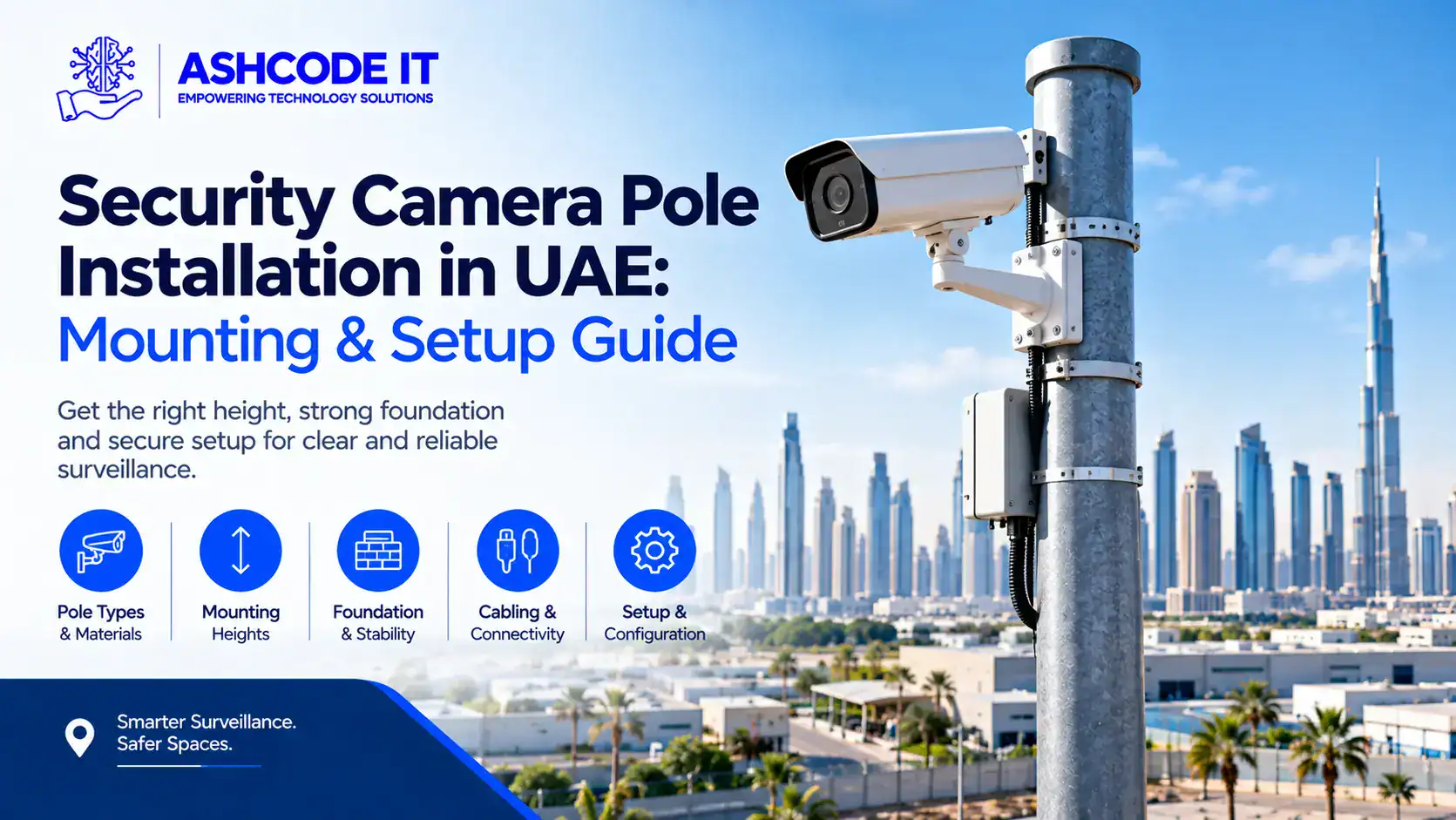
Security Camera Pole Installation in UAE helps businesses monitor large outdoor areas where wall-mounted cameras may not provide sufficient coverage. Parking lots, warehouses, construction sites, industrial facilities, and commercial properties often use camera poles to position CCTV equipment at suitable heights and viewing angles.
Choosing the right pole, foundation, mounting hardware, and camera location is essential for stable installation and clear surveillance footage. This guide explains the main pole types, installation considerations, and setup practices for UAE properties.
Why Use Security Camera Poles?
Security camera poles allow cameras to cover open areas, vehicle entrances, perimeter boundaries, and locations away from buildings.
Professional security camera pole installation in UAE can help businesses reduce blind spots and position cameras for better visibility.
Common applications include:
The appropriate pole height and camera position depend on the area being monitored and the level of detail required in recorded footage.
Types of CCTV Camera Poles
1. Galvanized Steel Camera Poles
Galvanized steel poles are commonly considered for outdoor surveillance because the protective zinc coating helps resist corrosion.
They can be suitable for parking facilities, industrial sites, commercial buildings, and perimeter monitoring.
Pole specifications should account for height, wall thickness, camera weight, wind exposure, and mounting requirements.
2. CCTV Poles with Mounting Brackets
These poles include mounting arrangements for fixed bullet cameras, dome cameras, or multiple surveillance devices.
Bracket selection should match the camera model and provide secure support for its weight and dimensions.
3. High-Mast Security Camera Poles
High-mast poles can position cameras above large open areas, including logistics yards, industrial premises, and extensive parking facilities.
Higher mounting positions can increase the field of view, but they may reduce facial or vehicle detail if cameras are placed too far from the target.
A site survey helps determine whether high-mast installation is appropriate.
4. Poles for PTZ Cameras
Pan-Tilt-Zoom cameras can rotate and zoom to monitor different areas.
Their poles and mounting brackets must support the camera’s weight, movement, and exposure to wind. Additional consideration may be necessary for vibration and cable protection.
How to Choose the Right Camera Pole Height
The required height depends on the camera type, target distance, mounting location, and purpose of surveillance.
| Approximate pole height | Potential application |
|---|
| 2–3 metres | Small entrances and selected close-range areas |
| 4–6 metres | Parking areas, commercial entrances, and perimeter monitoring |
| 6–9 metres | Larger yards and wider outdoor coverage |
| 10–12 metres or more | Selected industrial and high-mast applications |
These are general planning examples, not universal specifications. The appropriate height must be confirmed through a site assessment and structural design where required.
Mounting cameras too high can make it difficult to identify faces or number plates. Camera resolution, lens selection, lighting, and distance are equally important.
Security Camera Pole Installation Process
1. Conduct a Site Survey
Identify the areas requiring surveillance, potential blind spots, vehicle routes, lighting conditions, and available power or network connections.
The survey should also consider underground utilities, access for installation equipment, and nearby structures.
2. Select the Pole and Foundation
Choose a pole designed for the intended camera load and environmental conditions.
Foundation design should consider soil conditions, pole height, wind loads, and manufacturer specifications. Structural calculations and appropriate approvals may be necessary, particularly for tall poles.
3. Prepare Power and Network Connections
Cameras may require Ethernet cabling, fibre connectivity, power supplies, or wireless links.
Outdoor installations should use suitable weather-resistant cables, protected conduits, and appropriate electrical protection. Power and grounding work should be completed by qualified personnel.
4. Mount the Camera Securely
Install compatible brackets and secure the camera according to the manufacturer’s instructions.
Position the camera to cover the intended area while avoiding unnecessary recording of neighbouring properties or private spaces.
5. Configure and Test the System
After installation, configure the camera’s network settings, recording schedule, image quality, and access permissions.
Test day and night images, remote viewing, recording playback, and network connectivity before handing over the system.
Important Considerations for UAE Outdoor Installations
Outdoor equipment in the UAE may be exposed to high temperatures, dust, humidity, and strong winds.
When planning CCTV camera pole installation in UAE, consider the following:
Use outdoor-rated cameras and mounting hardware.
Check the equipment’s operating temperature range.
Select corrosion-resistant materials and suitable protective finishes.
Secure exposed cables and weatherproof connections.
Assess wind loading and structural stability.
Provide safe access for future maintenance.
Protect network devices and power supplies from environmental exposure.
For commercial sites, confirm any applicable CCTV installation requirements and permissions with the relevant local authority or property management before work begins.
Common Installation Mistakes to Avoid
Poor planning can reduce surveillance quality even when high-quality cameras are used.
Avoid selecting pole heights without assessing viewing distance, using unsuitable foundations, leaving cables exposed, and overlooking maintenance access.
It is also important to test night-time footage and ensure that camera placement provides the required level of detail.
Security Camera Pole Installation Services from Ashcode IT
Ashcode IT provides CCTV and IT infrastructure solutions for businesses across Dubai and the UAE. Our services include CCTV systems, surveillance networking, camera configuration, and related technical support.
For projects requiring outdoor camera mounting, discuss your site layout, camera specifications, pole requirements, and installation conditions with our team.
Contact Ashcode IT
Phone: +971 50 915 4423
Email: [email protected]
Website: www.ashcodeit.com