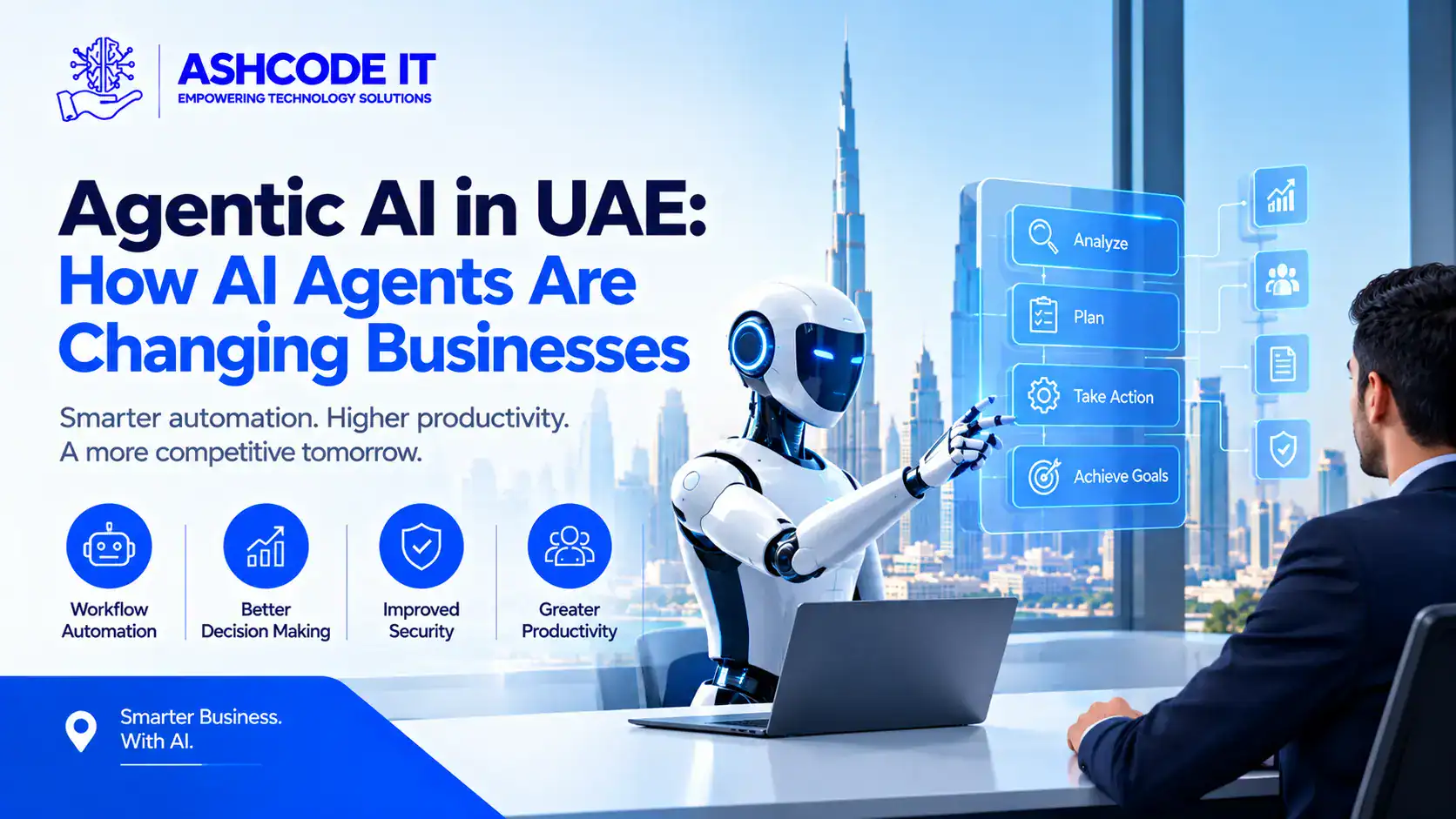
Agentic AI in UAE is becoming an important topic for businesses exploring how artificial intelligence can do more than answer questions or generate content. AI agents can interpret goals, plan steps, use approved tools, and carry out sequences of tasks with limited human intervention.
The UAE is actively advancing this technology. In May 2026, Dubai launched a two-year initiative to help the private sector transition towards agentic AI, while the federal government announced plans to introduce agentic AI across 50% of government sectors and operations within two years.
For businesses, this creates an opportunity to review existing workflows and identify where AI agents can support employees, customer service, IT operations, and decision-making.
What Is Agentic AI?
Agentic AI refers to AI systems that can work towards a defined goal by planning actions, using connected tools, reviewing results, and deciding on subsequent steps within their permitted scope.
Traditional AI tools typically respond to individual prompts. An AI agent may handle a sequence of related tasks.
For example, a conventional chatbot might explain how to report an IT problem. An AI agent could collect the issue details, check an approved support system, classify the request, create a ticket, and route it to the appropriate team.
Human approval should remain in place for sensitive actions, financial decisions, access changes, and other high-impact operations.
How Agentic AI Is Changing Businesses in the UAE
1. Customer Service Automation
AI agents can help manage routine enquiries, identify customer requirements, retrieve information from approved knowledge bases, and direct complex cases to employees.
For UAE businesses serving customers across different languages and time zones, these systems may help improve response coverage. Companies should test language accuracy, escalation processes, and response quality before deployment.
2. IT Support and Infrastructure Management
IT teams can use AI agents to support repetitive service desk and infrastructure tasks.
Possible applications include:
Categorising support tickets
Checking system alerts
Summarising technical incidents
Recommending troubleshooting steps
Updating ticket records
Escalating urgent issues
Actions such as disabling accounts, changing firewall rules, or modifying production systems should require suitable permissions, testing, and human authorization.
3. Finance and Administrative Workflows
AI agents can assist with invoice data extraction, purchase request routing, document checks, and report preparation. They can compare information across approved business systems and flag missing details for review.
However, payment approvals, financial transfers, and changes to supplier bank details should not be left to an autonomous agent without strong verification and approval controls.
4. Sales and Marketing Operations
Sales teams can use agents to organise enquiries, summarise customer interactions, prepare draft follow-up emails, and update customer relationship management records.
Marketing teams may use them to research topics, organise campaign data, and prepare draft content. Human review remains important for brand consistency, factual accuracy, customer privacy, and advertising compliance.
5. Human Resources
AI agents can assist with routine HR enquiries, onboarding checklists, interview scheduling, and employee document workflows.
Sensitive decisions involving recruitment, performance, compensation, or employee rights should remain subject to meaningful human oversight. Businesses should also assess whether the system treats applicants and employees fairly.
What Businesses Should Consider Before Adopting Agentic AI
Successful adoption requires more than selecting an AI platform. Businesses should begin by identifying repetitive workflows, assessing data quality, and defining which actions an agent can perform.
Important considerations include:
Data security: Restrict access to confidential customer and company information.
Human oversight: Require approval for sensitive or irreversible actions.
System integration: Confirm compatibility with existing business software.
Performance monitoring: Track accuracy, completion rates, errors, and cost savings.
Employee training: Help staff understand how to supervise AI-assisted workflows.
The UAE’s current AI initiatives also emphasise capability building and responsible implementation. Businesses should establish clear ownership and governance before expanding agentic AI across departments.
The Future of Agentic AI in the UAE
Agentic AI is moving from experimentation towards practical business applications. Dubai’s private-sector initiative and the UAE government’s adoption plans signal growing interest in AI systems that can execute workflows rather than simply generate responses.
For companies, the best starting point is a controlled pilot with a measurable objective, such as reducing service desk processing time or automating routine document checks. Results can then guide decisions about wider deployment.
How Ashcode IT Can Support Your AI Readiness
Ashcode IT provides IT infrastructure, cybersecurity, networking, server solutions, and technology support for businesses in Dubai and across the UAE. A secure IT foundation can help organizations prepare their systems and processes for AI adoption.
Contact Ashcode IT