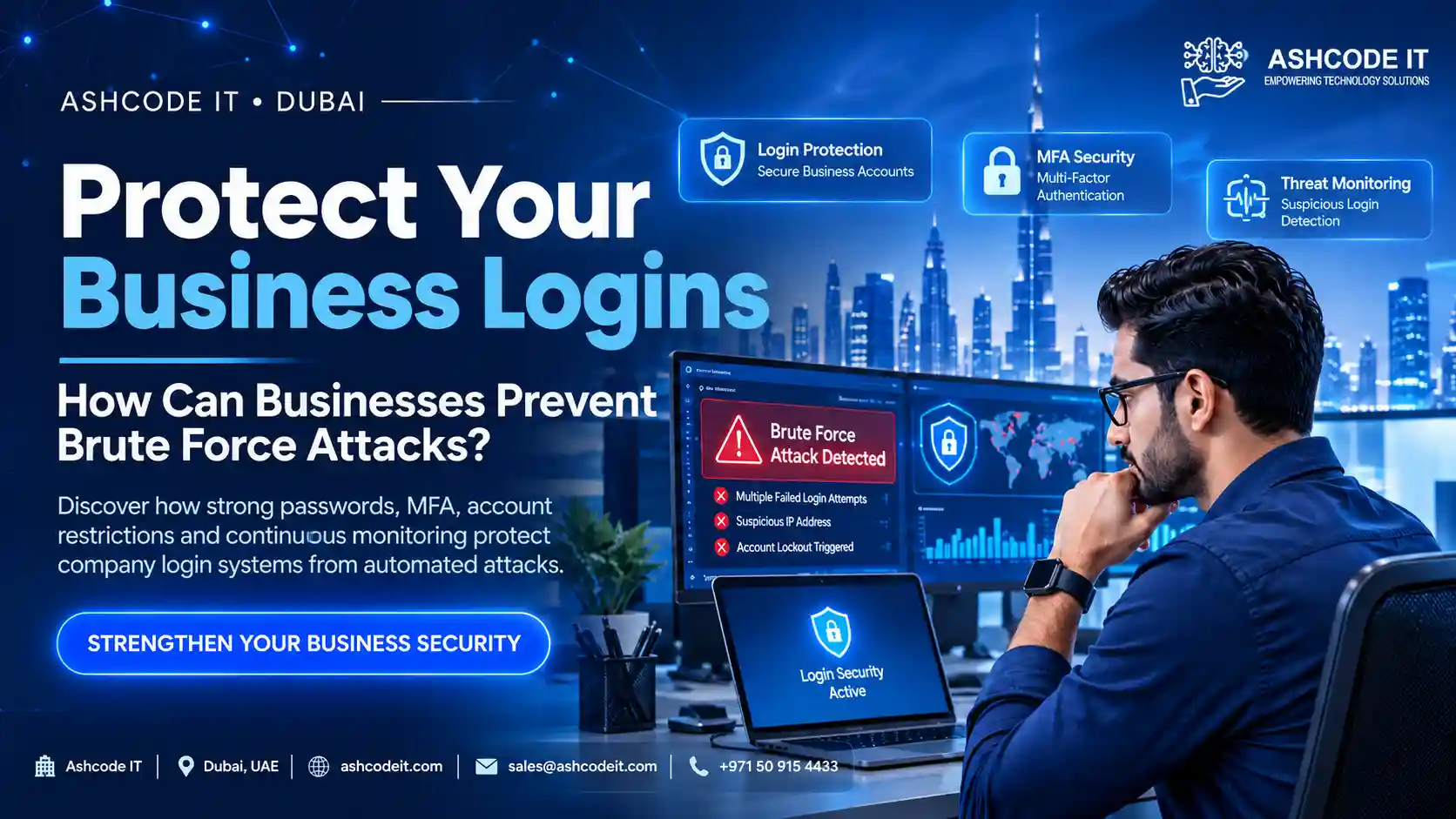
Business login systems protect sensitive information, employee accounts, financial records and internal applications. However, cybercriminals continuously attempt to access these systems by guessing passwords through automated tools. Without appropriate security measures, organisations can experience serious data breaches and operational disruptions.
Brute force attacks on company login systems are cybersecurity threats in which attackers repeatedly attempt different username and password combinations until they discover valid credentials. These attacks commonly target business email accounts, administrative dashboards, cloud platforms, remote desktop services and enterprise applications.
As businesses increasingly depend on digital infrastructure, protecting authentication systems has become essential. Preventing brute force attacks on company login systems requires strong password policies, multi-factor authentication, account restrictions and continuous security monitoring.
Ashcode IT helps organisations strengthen their IT infrastructure through cybersecurity solutions, endpoint protection, network security and managed IT support.
What Are Brute Force Attacks on Company Login Systems?
A brute force attack is a technique used by cybercriminals to gain unauthorised access by repeatedly testing different password combinations. Attackers often use automated scripts and specialised software to perform thousands of login attempts.
Common types include:
Traditional brute force attacks: Attackers systematically test different password combinations.
Dictionary attacks: Common words, phrases and frequently used passwords are tested against employee accounts.
Credential stuffing: Previously stolen usernames and passwords are reused across different business platforms.
Password spraying: Attackers test a small number of common passwords against multiple employee accounts.
Reverse brute force attacks: Attackers start with a known password and attempt to identify accounts associated with it.
Understanding these techniques helps organisations identify vulnerabilities and develop effective strategies against brute force attacks on company login systems.
Why Are Company Login Systems Targeted by Cybercriminals?
Business login portals provide access to valuable information and critical applications. An attacker who successfully compromises an employee or administrator account may gain access to confidential documents, customer information, financial applications and company infrastructure.
Several factors make business authentication systems attractive targets:
Weak or reused employee passwords.
Login portals exposed directly to the internet.
Missing multi-factor authentication.
Outdated applications and authentication software.
Poor monitoring of repeated login failures.
Excessive user permissions.
Unsecured remote access services.
Successful brute force attacks on company login systems can result in data theft, business email compromise, ransomware incidents and unauthorised system changes.
How Can Businesses Prevent Brute Force Attacks on Company Login Systems?
Organisations should implement multiple layers of authentication protection rather than depending on a single security measure. The following practices can help businesses reduce unauthorised access risks.
1. Enforce Strong Password Policies
Weak passwords make it easier for attackers to compromise employee accounts. Businesses should establish password policies that encourage employees to create long, unique and difficult-to-guess passwords.
Recommended practices include:
Require passwords with at least 14 characters where supported.
Encourage the use of memorable passphrases.
Block commonly used and compromised passwords.
Prevent password reuse across business applications.
Use an approved business password manager.
Change passwords immediately when compromise is suspected.
Strong password management is one of the first steps in preventing brute force attacks on company login systems. Employees should also receive regular security awareness training to understand password-related risks.
2. Enable Multi-Factor Authentication (MFA)
Multi-factor authentication adds another verification step beyond a username and password. Even if an attacker discovers an employee’s password, access remains protected by an additional authentication requirement.
Businesses can implement:
Phishing-resistant authentication methods, including FIDO2 security keys and passkeys, provide particularly strong protection.
MFA should be enabled for administrator accounts, company email, VPN connections, cloud platforms and other critical applications. This additional security layer makes successful brute force attacks on company login systems significantly more difficult.
3. Configure Account Lockout and Login Rate Limiting
Repeated login attempts should trigger additional security controls. Businesses can configure authentication systems to temporarily restrict access after suspicious login activity.
For example, organisations can introduce:
Progressive delays after repeated failed attempts.
Temporary account restrictions.
Rate limiting for login requests.
CAPTCHA or other bot-detection mechanisms when appropriate.
Additional verification for suspicious authentication activity.
Permanent account lockouts should be avoided because attackers could deliberately trigger them to disrupt employee access.
These measures help prevent automated brute force attacks on company login systems while maintaining a practical login experience for legitimate users.
Continuous monitoring helps IT administrators identify unusual authentication behaviour before an incident becomes serious.
Businesses should monitor:
Multiple failed login attempts.
Login requests from unfamiliar locations.
Access attempts outside normal working hours.
Repeated authentication requests across multiple accounts.
Unexpected administrator account activity.
Unusual login patterns from unfamiliar devices or IP addresses.
Security Information and Event Management (SIEM) solutions can collect and analyse authentication logs from different systems. Automated alerts can notify IT teams when suspicious behaviour is detected.
Effective monitoring allows businesses to identify potential brute force attacks on company login systems and investigate suspicious activity before attackers gain access.
5. Restrict Access to Administrative Accounts
Administrator accounts have elevated privileges and can make significant changes to company systems. If attackers compromise these accounts, the consequences can be particularly serious.
Businesses should follow the principle of least privilege by providing employees with only the access necessary for their responsibilities.
Additional precautions include:
Use separate administrator and standard employee accounts.
Restrict administrative access to authorised devices.
Require MFA for privileged accounts.
Disable unused administrator accounts.
Review permissions regularly.
Monitor privileged login activity.
Restricting privileged access reduces the potential damage associated with brute force attacks on company login systems and compromised credentials.
6. Use IP Restrictions and Network-Level Protection
Businesses can reduce exposure by limiting access to sensitive login portals. Network-level security controls provide an additional barrier against suspicious authentication requests.
Organisations can implement:
VPN-based access for internal applications.
IP allowlisting for administrative interfaces.
Web Application Firewalls (WAF).
Network intrusion detection systems.
Geographic access policies where appropriate.
Bot detection and suspicious traffic filtering.
These technologies help businesses reduce automated login attempts and strengthen protection against brute force attacks on company login systems.
Outdated authentication platforms, operating systems and applications may contain vulnerabilities that attackers can exploit.
Businesses should establish a regular patch management process covering:
Operating system security updates.
Web application updates.
Authentication software.
VPN and firewall firmware.
Identity management platforms.
Security monitoring tools.
Regular vulnerability assessments can also help identify weaknesses before cybercriminals exploit them. Keeping systems updated strengthens the overall security strategy against brute force attacks on company login systems.
What Should Businesses Do When a Brute Force Attack Is Detected?
Detecting suspicious authentication activity is only the first step. Businesses need a clear incident response procedure to limit potential damage.
If a potential attack is identified, IT administrators should:
Review authentication logs to identify affected accounts.
Temporarily restrict suspicious sessions or accounts where necessary.
Revoke active sessions and access tokens when compromise is suspected.
Reset compromised credentials and review MFA settings.
Investigate unfamiliar devices, IP addresses and login locations.
Check for unauthorised account changes and permission modifications.
Strengthen affected security policies.
Document the incident and communicate with relevant stakeholders.
A structured incident response process helps organisations recover quickly and reduce the likelihood of recurring brute force attacks on company login systems.
How Can Managed IT Support Improve Business Login Security?
Managing authentication security across multiple employees, applications and devices can become difficult without dedicated IT resources.
Managed IT support helps businesses maintain consistent security practices through continuous monitoring, configuration management, vulnerability assessments and technical assistance.
Ashcode IT supports organisations with IT security and infrastructure management, helping businesses improve their overall cybersecurity posture.
Professional IT support can assist with:
Implementing MFA across business applications.
Configuring password and account security policies.
Monitoring suspicious authentication activity.
Managing employee access permissions.
Reviewing firewall and network configurations.
Maintaining security updates.
Supporting incident investigation and recovery.
With professional monitoring and security management, organisations can strengthen their defences against brute force attacks on company login systems and other authentication-related threats.