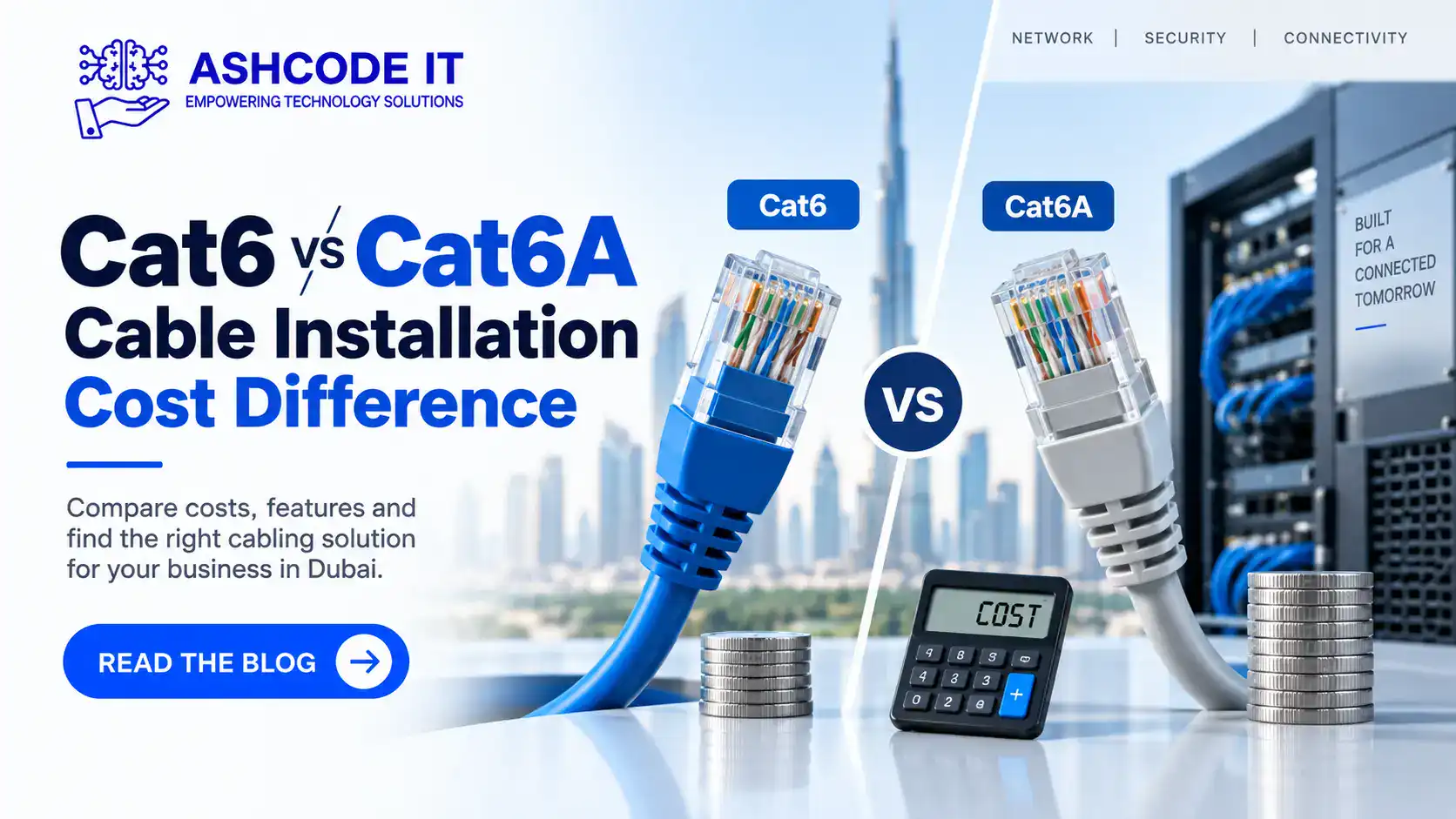
Cat6 vs Cat6A Cable Installation Cost Difference

Cat6 vs Cat6A Cable Installation Cost Difference

Choosing the right network cable is an important part of planning office IT infrastructure. For businesses in Dubai and across the UAE, Cat6 vs Cat6A cable installation cost difference is often a key consideration when planning structured cabling projects.

While Cat6 can be a practical choice for many standard office networks, Cat6A offers higher bandwidth capacity and better support for demanding network environments. The installation cost difference depends not only on the cable itself but also on connectors, patch panels, installation complexity, labor, testing, and the size of the project.

This guide explains the differences between Cat6 and Cat6A, the factors affecting installation costs, and how businesses can decide which option suits their infrastructure.

Cat6 vs Cat6A: Quick Comparison

FeatureCat6Cat6A
Maximum rated frequency250 MHz500 MHz
Typical maximum Ethernet speed1 GbpsUp to 10 Gbps
10GbE distanceTypically up to 55 m under applicable conditionsUp to 100 m
Cable constructionGenerally thinner/easier to handleGenerally thicker
Installation complexityLowerHigher
CostLowerHigher
Best suited forStandard office networksHigh-performance & future-ready networks

The actual performance of an installed cabling system depends on the complete channel, including cable, connectors, patch panels, installation quality, and testing.


What Is Cat6 Cable?

Cat6 is a widely used twisted-pair Ethernet cable for business networking.

It can support Gigabit Ethernet and has a rated bandwidth of 250 MHz. With properly selected components and installation practices, Cat6 can be suitable for many offices, small businesses, retail environments, and general-purpose network deployments.

Cat6 is commonly used for:

  • Office LAN networks
  • Computers and workstations
  • VoIP phones
  • Wireless access points
  • Printers
  • Network switches
  • IP CCTV cameras
  • General business connectivity

For businesses with standard networking requirements, Cat6 can provide a cost-effective structured cabling foundation.

What Is Cat6A Cable?

Cat6A is an enhanced version of Category 6 cabling.

It is rated at 500 MHz and is designed to support 10 Gigabit Ethernet up to 100 metres as part of a compliant cabling channel.

Cat6A is particularly relevant for businesses planning higher network speeds, larger data transfers, or longer-term infrastructure requirements.

Cat6A is commonly considered for:

  • Enterprise offices
  • Data-intensive work environments
  • Server rooms
  • Data centers
  • High-density WiFi deployments
  • 10GbE networks
  • Advanced IP surveillance infrastructure

Cat6 vs Cat6A Cable Installation Cost Difference

There is no single installation price for every UAE project.

The Cat6 vs Cat6A cable installation cost difference depends on several variables, including:

  • Cable quality and brand
  • Cable length
  • Number of network points
  • Patch panels
  • Keystone jacks
  • Faceplates
  • Racks and cabinets
  • Cable trays
  • Labor requirements
  • Testing and certification
  • Existing infrastructure
  • Ceiling accessibility
  • Project location

As a general planning principle, Cat6A installations tend to cost more than Cat6 installations because the cable and associated components can be more expensive and the thicker cable can require additional installation effort.

A professional site survey is the best way to obtain an accurate quotation.

Why Is Cat6A More Expensive to Install?

The cost difference isn’t simply the price of the cable.

1. Cable Material

Cat6A cable generally has a more robust construction designed to meet higher performance requirements.

Depending on the manufacturer and specification, this can increase material costs.

2. Installation Requirements

Cat6A cables are generally thicker and less flexible than Cat6.

This can make:

  • Cable routing
  • Bending
  • Termination
  • Rack organization

more demanding.

Installers need to respect the manufacturer’s bend-radius and separation requirements.

3. Compatible Components

A structured cabling system isn’t just the cable.

A Cat6A installation may require compatible:

  • Patch panels
  • Keystone modules
  • Connectors
  • Patch cords
  • Faceplates

Using mismatched components can compromise the performance of the overall channel.

4. Testing & Certification

Professional structured cabling should be tested after installation.

Testing can identify:

  • Wire mapping problems
  • Excessive attenuation
  • Crosstalk
  • Termination issues
  • Performance failures

For enterprise deployments, certification testing provides additional assurance that the installed cabling meets the relevant category requirements.

Is Cat6A Worth the Additional Cost?

This depends on your business requirements.

If your organization primarily needs standard Gigabit connectivity for computers, printers, VoIP phones, and general office applications, Cat6 may be sufficient.

However, Cat6A can make more sense when you are planning:

  • 10GbE connectivity
  • High-density wireless networks
  • Large file transfers
  • Data-intensive applications
  • New enterprise offices
  • Long-term infrastructure upgrades

The question shouldn’t simply be “Which cable is cheaper?”

A better question is:

Which cabling system provides the performance and lifespan your business needs without unnecessary investment?

Cat6 vs Cat6A for WiFi Access Points

Modern WiFi deployments can place additional demands on structured cabling.

Businesses deploying high-performance wireless access points should consider:

  • Required Ethernet speed
  • PoE requirements
  • Cable distances
  • Future network upgrades
  • Number of access points

For a new enterprise office where higher-speed uplinks may be required in the future, Cat6A can be worth considering.

Cat6 vs Cat6A for CCTV

Both Cat6 and Cat6A can be used for IP CCTV infrastructure when the complete system is designed correctly.

For most standard IP cameras, Cat6 may be sufficient.

Cat6A becomes more relevant where businesses are building higher-capacity network infrastructure or want greater cabling headroom for future upgrades.

The camera’s bandwidth requirements, cable distance, PoE requirements, and network architecture should determine the final choice.

Cat6 vs Cat6A Installation for New Offices

If you’re building a new office in Dubai, choosing cabling during the initial construction or fit-out stage can be more economical than replacing it later.

Consider:

Choose Cat6 when:

  • Your network requirements are primarily Gigabit
  • The project has a tight infrastructure budget
  • Your applications don’t require 10GbE
  • The office has standard connectivity requirements

Consider Cat6A when:

  • You want 10GbE support across standard channel distances
  • You’re building a high-performance enterprise network
  • You expect bandwidth requirements to increase
  • You are planning a long-term structured cabling infrastructure

Don’t Compare Cable Prices Alone

One common mistake businesses make is comparing only the per-meter price.

The real project cost includes:

Cable + Termination + Patch Panels + Racks + Accessories + Labor + Testing + Documentation

A cheaper cable can become an expensive choice if it requires replacement after a network upgrade.

Likewise, installing Cat6A everywhere may not be necessary if the business only needs basic Gigabit connectivity.

A professional network designer can help balance current requirements with future expansion.

What Does Professional Structured Cabling Installation Include?

A complete structured cabling project may include:

  1. Site survey
  2. Network design
  3. Cable route planning
  4. Cat6/Cat6A cable installation
  5. Patch panel termination
  6. Rack installation
  7. Labeling
  8. Cable management
  9. Faceplate installation
  10. Network testing
  11. Certification
  12. Documentation

Professional installation helps create a cleaner, easier-to-maintain network infrastructure.

Why Structured Cabling Matters in UAE Offices

Businesses in Dubai and across the UAE increasingly depend on:

  • Cloud applications
  • VoIP
  • Video conferencing
  • Enterprise WiFi
  • IP CCTV
  • Network storage
  • Business applications

A properly designed structured cabling system provides the physical foundation for these technologies.

ASHCODE IT provides structured cabling and IT infrastructure solutions for businesses across Dubai and the UAE.

Why Choose ASHCODE IT for Structured Cabling?

ASHCODE IT helps businesses plan and deploy professional network infrastructure based on their operational requirements.

Our IT infrastructure services can include:

  • Cat6 cabling
  • Cat6A cabling
  • Network installation
  • WiFi infrastructure
  • Server room setup
  • Rack and patch panel installation
  • Fiber optic networking
  • Network testing
  • IT infrastructure support

Rather than selecting a cable purely by price, our team can assess your environment and recommend an appropriate infrastructure approach.

Frequently Asked Questions

Is Cat6A more expensive than Cat6?

Generally, yes. Cat6A systems typically have higher material and installation costs because of the cable construction and compatible components required.

How much more does Cat6A installation cost?

There is no fixed percentage that applies to every UAE project. The difference depends on cable brand, quantity, installation conditions, components, labor, and testing requirements. A site survey is recommended for an accurate quotation.

Is Cat6 enough for an office?

For many standard office networks requiring Gigabit Ethernet, Cat6 can be suitable. The final choice should be based on network speed, cable distances, applications, and future requirements.

Is Cat6A better for 10GbE?

Cat6A is designed to support 10 Gigabit Ethernet up to 100 metres under the applicable cabling standards and installation conditions.

Should I install Cat6A in a new office?

Cat6A can be a sensible option when you want a higher-performance cabling infrastructure and anticipate future bandwidth requirements. However, it may not be necessary for every office.

Can Cat6 and Cat6A be used together?

Yes. They can coexist within an overall network infrastructure, but the performance of a particular link is determined by its components and the applicable category of the complete channel.

Final Thoughts

The Cat6 vs Cat6A cable installation cost difference should be evaluated as part of the entire network infrastructure investment rather than by cable price alone.

Cat6 can be an economical solution for many standard office networks, while Cat6A provides greater bandwidth capability and is designed for 10GbE transmission over up to 100 metres.

For businesses in Dubai and the UAE, the right choice depends on network requirements, project size, budget, physical installation conditions, and future expansion plans.

Need help planning your structured cabling project?

Contact ASHCODE IT

Phone: +971 50 9154423
Email: [email protected]
Website: ashcodeit.com

ASHCODE IT — Empowering Technology Solutions for UAE Businesses.

Scroll to Top