


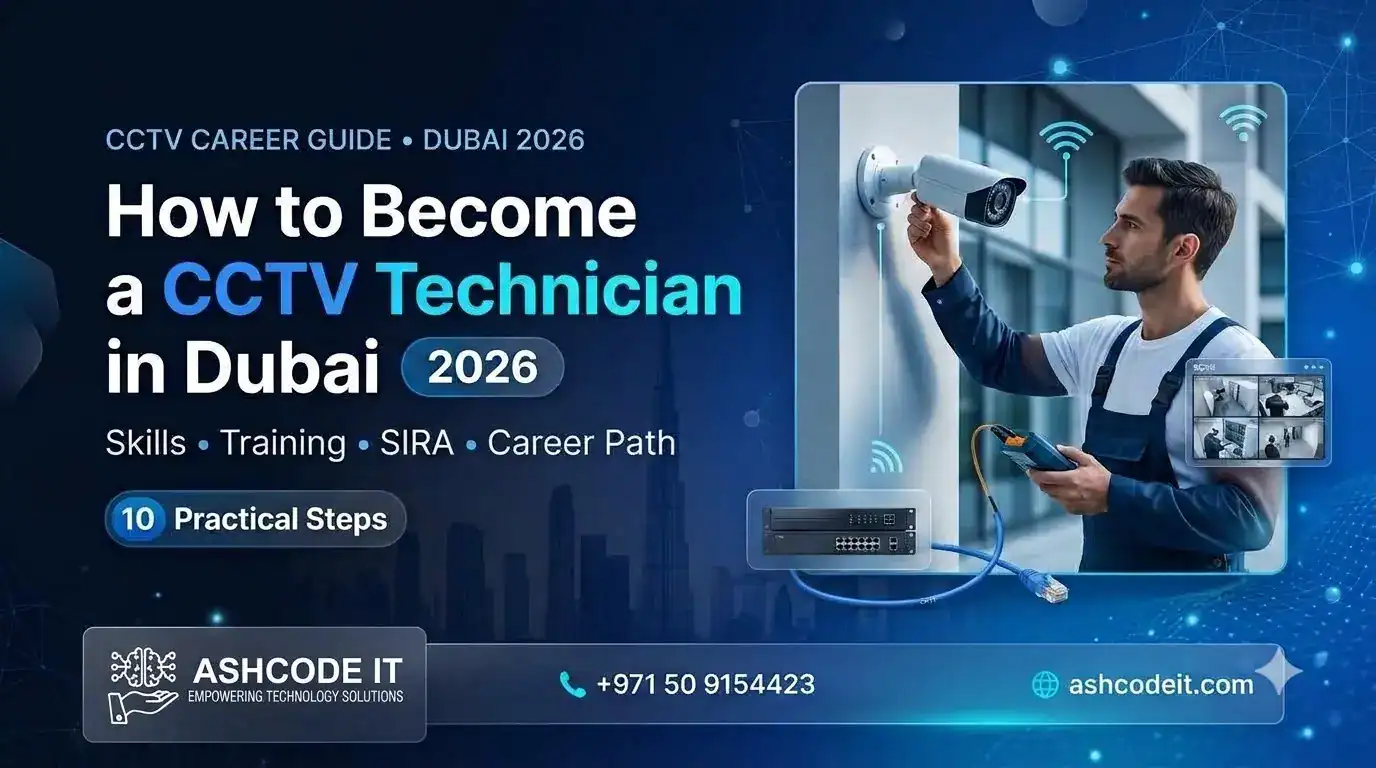
How to Become a CCTV Technician in Dubai (2026) is a common question among people interested in CCTV installation, ELV systems, networking and security technology careers in the UAE. Dubai has CCTV systems across commercial buildings, offices, warehouses, hotels, retail stores, residential properties and other facilities, creating technical roles related to installation, configuration and maintenance.
Becoming a CCTV technician involves more than learning how to mount a camera. A professional technician should understand CCTV cameras, DVR and NVR systems, IP networking, cabling, storage, troubleshooting and applicable Dubai security requirements.
For certain regulated security-system roles in Dubai, Security Industry Regulatory Agency (SIRA) requirements also apply.
This guide explains the skills, qualifications, training, SIRA requirements and career path you should understand when exploring CCTV Technician Jobs in Dubai in 2026.
Table of Contents
ToggleWhat Does a CCTV Technician Do in Dubai?
Before learning How to Become a CCTV Technician in Dubai (2026), it is important to understand the job.
A CCTV technician installs, configures, tests, maintains and troubleshoots video surveillance systems.
Typical responsibilities include:
- Installing CCTV cameras
- Running network and power cables
- Installing DVR and NVR systems
- Configuring IP cameras
- Setting camera angles
- Installing PoE switches
- Configuring recording schedules
- Setting up storage
- Testing camera feeds
- Configuring remote viewing
- Diagnosing camera faults
- Replacing damaged equipment
- Performing preventive maintenance
- Testing network connectivity
- Preparing service reports
- Supporting customers onsite
- Maintaining technical documentation
Technicians working in broader ELV roles may also support access control, intercoms, structured cabling and related low-voltage systems.
How to Become a CCTV Technician in Dubai (2026): Step-by-Step
If you want to build a career as a CCTV Technician in Dubai, follow a structured learning and career path.
Step 1: Learn CCTV Fundamentals
Start by understanding how a complete CCTV system works.
You should know the purpose of:
- CCTV cameras
- IP cameras
- Analog cameras
- DVRs
- NVRs
- Hard drives
- PoE switches
- Network switches
- Power supplies
- Connectors
- Network cables
- Monitors
- Video management software
Understanding the complete system makes troubleshooting easier.
For example, if a camera is offline, the problem may not be the camera itself. It could be caused by the cable, PoE switch, power supply, network configuration, recorder or software.
Step 2: Learn CCTV Camera Installation
Practical installation skills are essential for CCTV Technician Jobs in Dubai.
A technician should know how to:
- Select suitable camera positions
- Mount cameras safely
- Run cables properly
- Terminate cables
- Install connectors
- Connect cameras to DVRs or NVRs
- Connect IP cameras to switches
- Adjust viewing angles
- Reduce blind spots
- Test video quality
- Protect outdoor connections
- Label cables
- Maintain organized racks
Good installation work should be technically functional, neat and easy to maintain.
Step 3: Learn IP CCTV Networking
Modern CCTV systems frequently depend on IP networking. Basic networking knowledge can therefore significantly improve your technical capability.
A CCTV Technician in Dubai should understand:
- IP addresses
- Subnet masks
- Default gateways
- DNS
- DHCP
- Static IP addresses
- LAN
- PoE
- Network switches
- Routers
- Basic VLAN concepts
- Port connectivity
- Network testing
Suppose an IP camera is physically installed but cannot communicate with the NVR. A technician should be able to determine whether the problem is related to the IP address, cable, switch, power or network configuration.
Step 4: Learn DVR and NVR Configuration
Installing cameras is only one part of CCTV work.
A professional technician should be comfortable configuring recording equipment.
Learn how to:
- Add cameras to an NVR
- Configure recording schedules
- Change camera names
- Set date and time
- Configure storage
- Create users
- Assign permissions
- Search recordings
- Export footage
- Configure motion recording
- Check hard-drive status
- Set retention options
- Configure remote access
These skills are commonly required in practical CCTV Technician Jobs in Dubai.
What Qualifications Are Needed to Become a CCTV Technician in Dubai?
Employers may have different educational requirements depending on the position.
Relevant educational backgrounds can include:
- Diploma in Electronics
- Diploma in Electrical Engineering
- Diploma in Computer Hardware
- Diploma in Networking
- Diploma in Information Technology
- Electronics Engineering
- Electrical Engineering
- Computer Science
- Information Technology
For regulated Security Systems Technician roles, candidates should pay particular attention to the current SIRA eligibility requirements rather than assuming that general CCTV experience alone is sufficient.
SIRA Requirements for CCTV Technicians in Dubai
This is one of the most important parts of understanding How to Become a CCTV Technician in Dubai (2026).
Dubai’s private security sector is regulated by the Security Industry Regulatory Agency (SIRA).
For the current Security Systems Technician cadre, SIRA lists requirements including:
- Emirates ID
- Valid UAE residency
- Good Conduct Certificate issued by Dubai Police and addressed to SIRA
- Completion of the Security Systems Technician course through an approved training centre
- Age between 21 and 60
The application for a Security Cadre Card is handled within the SIRA framework, and the current listed fee for the Security Systems Technician category is AED 320.
Candidates should always check the latest SIRA requirements before applying because regulations, documentation, fees and procedures can change.
Is SIRA Certification Required for CCTV Technician Jobs in Dubai?
For security-system work falling under SIRA-regulated activities, the applicable SIRA licensing and personnel requirements matter.
SIRA states that its Security Cadre Card allows holders to practise professions related to Dubai’s private security sector. Security Systems Technician is specifically listed as one of its cadre categories.
This is why job seekers should distinguish between general electronics/IT work and regulated security-system positions.
A company involved in the Installation of Security Devices and Equipment is also subject to SIRA’s business licensing requirements. SIRA currently specifies minimum technical staffing arrangements for this activity.
When reviewing a vacancy, ask the employer whether the position requires an existing SIRA card, whether training is arranged by the company, and what category applies to the role.
Step 5: Gain Hands-On CCTV Experience
Practical experience is one of the most valuable parts of becoming a CCTV Technician in Dubai.
Watching installation videos is useful for learning concepts, but technicians also need hands-on troubleshooting ability.
Try to gain practical experience with:
- Dome cameras
- Bullet cameras
- PTZ cameras
- IP cameras
- DVR systems
- NVR systems
- PoE switches
- CAT6 cabling
- Network racks
- CCTV hard drives
- Power supplies
- Monitors
- Video management software
Hands-on practice helps you understand problems that may not be obvious from theoretical training.
Step 6: Learn Popular CCTV Brands
Employers may use different manufacturers depending on the project.
Experience with widely used CCTV platforms can improve your flexibility. Useful areas to learn include systems from manufacturers such as:
- Hikvision
- Dahua
- Axis
- Hanwha Vision
- Bosch
- Uniview
Instead of memorizing only one brand’s interface, understand the core principles behind camera activation, IP configuration, recording, storage and troubleshooting.
This makes it easier to adapt when an employer uses a different system.
Step 7: Learn Structured Cabling
CCTV technicians frequently work with network cabling.
Useful skills include:
- CAT6 cable termination
- RJ45 crimping
- Patch panel termination
- Cable testing
- Cable labeling
- Rack organization
- Cable management
- Fiber basics
- Network outlet installation
Poor cabling can cause unstable camera feeds, connectivity problems and difficult maintenance.
Strong cabling skills can also help candidates move toward broader ELV and network-support positions.
Step 8: Learn CCTV Troubleshooting
Troubleshooting is what separates basic installation knowledge from professional technical support.
A technician should learn how to diagnose problems such as:
- Camera offline
- No video
- Blurry image
- Night vision failure
- Recording failure
- Hard-drive errors
- NVR not detecting a camera
- Network disconnection
- IP address conflicts
- PoE problems
- Remote viewing failure
- Password issues
- Intermittent video
- Damaged cables
- Power supply problems
Use a logical process rather than immediately replacing equipment.
For example:
Camera offline → Check power → Check cable → Check switch port → Check IP address → Ping device → Check NVR configuration → Test camera separately.
A systematic approach can reduce troubleshooting time.
Step 9: Learn Access Control and Other ELV Systems
Candidates searching for CCTV Technician Jobs in Dubai may also encounter vacancies advertised as CCTV/ELV Technician.
ELV knowledge can broaden your career options.
Consider learning:
Access Control
- Biometric readers
- Card readers
- Door controllers
- Electromagnetic locks
- Exit buttons
- Door sensors
Video Intercom
Learn installation and basic configuration of indoor and outdoor intercom units.
Structured Cabling
Understand data points, patch panels, network racks and testing.
Gate Barriers
Learn the basic operation of vehicle access systems and their integration with access-control technology.
A technician who understands several related systems can potentially progress toward senior ELV positions.
Step 10: Prepare a CCTV Technician CV for Dubai
Your CV should clearly show your practical skills.
Instead of simply writing:
“Worked as CCTV Technician.”
Describe what you actually handled.
For example:
CCTV Technician – Key Responsibilities
- Installed IP and analog CCTV cameras
- Configured DVR and NVR systems
- Installed CAT6 network cabling
- Configured IP addresses and PoE switches
- Performed CCTV preventive maintenance
- Diagnosed recording and connectivity issues
- Configured remote camera viewing
- Supported access-control installations
- Prepared installation and service reports
Also mention relevant brands, certifications, years of experience and the types of projects you have worked on.
Skills Required for CCTV Technician Jobs in Dubai
Candidates researching How to Become a CCTV Technician in Dubai (2026) should develop a combination of technical and professional skills.
| Skill | Why It Matters |
|---|---|
| CCTV Installation | Core requirement for camera projects |
| IP Networking | Important for modern IP CCTV |
| DVR/NVR Configuration | Required for recording systems |
| CAT6 Cabling | Used for IP camera connectivity |
| PoE | Commonly used to power IP cameras |
| Troubleshooting | Essential for maintenance |
| Access Control | Useful for ELV positions |
| Documentation | Important for service and handover |
| Customer Communication | Needed for onsite support |
| Safety Awareness | Important for installation work |
Do CCTV Technicians Need Networking Knowledge?
Yes, networking knowledge is increasingly useful for CCTV work.
Modern IP surveillance systems operate across computer networks. A technician who understands networking can diagnose problems more effectively.
Important concepts include:
- Static IP addressing
- DHCP
- Subnetting basics
- Gateways
- PoE
- Network switches
- Bandwidth
- Routers
- Remote connectivity
- Basic VLANs
This knowledge can also help a CCTV Technician in Dubai progress toward network support, security systems engineering or broader IT infrastructure roles.
CCTV Technician vs ELV Technician
These job titles are related but not identical.
| CCTV Technician | ELV Technician |
|---|---|
| CCTV camera installation | CCTV installation |
| DVR/NVR configuration | Access control |
| CCTV maintenance | Intercom systems |
| IP camera setup | Structured cabling |
| Camera troubleshooting | Gate barriers |
| Recording systems | Multiple low-voltage systems |
A CCTV technician specializes primarily in surveillance systems, while an ELV technician may support several low-voltage technologies.
CCTV Technician Career Path in Dubai
A career does not have to stop at CCTV installation.
With experience and additional skills, a technician may progress through roles such as:
Assistant Technician → CCTV Technician → CCTV/ELV Technician → Senior Technician → Security Systems Engineer → ELV Supervisor → Project Engineer → Project Manager
The exact progression depends on qualifications, practical experience, licensing requirements and the employer.
Candidates interested in engineering-level security-system positions should note that SIRA maintains a separate Security Systems Engineer category with its own requirements.
Common Mistakes New CCTV Technicians Should Avoid
Learning Only Camera Installation
A technician should understand the complete system, including networking, recording, storage and troubleshooting.
Ignoring Networking
IP networking has become an important part of CCTV installation.
Poor Cable Management
Unorganized cabling makes maintenance difficult and can create unnecessary faults.
Ignoring Documentation
Always record device information, IP addresses, passwords according to company policy, cable labels and system configurations.
Depending on One CCTV Brand
Learn the principles behind CCTV technology rather than depending entirely on one manufacturer’s interface.
Ignoring Dubai Regulatory Requirements
Technical ability alone does not replace applicable regulatory requirements. Candidates pursuing regulated security-system roles should verify current SIRA requirements.
Frequently Asked Questions
How to Become a CCTV Technician in Dubai (2026)?
Start by learning CCTV installation, DVR/NVR configuration, IP networking, structured cabling and troubleshooting. Gain practical experience and check the applicable SIRA requirements for the Security Systems Technician role before pursuing regulated CCTV work in Dubai.
Do I need SIRA certification to work as a CCTV technician in Dubai?
SIRA regulates Dubai’s private security sector and lists Security Systems Technician as a Security Cadre category. Candidates pursuing roles involving regulated security-system activities should confirm the applicable SIRA licensing requirements with the employer and SIRA.
What skills are required for CCTV Technician Jobs in Dubai?
Important skills include CCTV installation, IP networking, DVR/NVR configuration, CAT6 cabling, PoE, storage configuration, maintenance and troubleshooting.
Can a fresher become a CCTV technician in Dubai?
A fresher can begin developing CCTV and ELV skills through technical training and practical experience. However, regulated SIRA Security Systems Technician positions have specific eligibility and training requirements, so candidates should verify whether they meet the current criteria.
Is networking required for CCTV technicians?
Networking knowledge is highly useful because modern IP cameras, NVRs, PoE switches and remote monitoring systems rely on network connectivity.
Which CCTV brands should I learn?
Learning systems from manufacturers such as Hikvision, Dahua, Axis, Hanwha Vision, Bosch and Uniview can be useful. More importantly, understand the underlying principles of IP CCTV systems so you can adapt to different brands.
Can a CCTV technician become an ELV engineer?
A technician can progress toward broader ELV and engineering roles by gaining experience and relevant qualifications in CCTV, access control, networking, structured cabling, intercoms and security-system design. Engineering roles can have additional qualification and SIRA requirements.
Is a UAE driving licence useful for CCTV technicians?
A UAE driving licence can be valuable for field technicians who need to travel between customer sites, attend maintenance calls and transport tools or equipment. Whether it is mandatory depends on the employer.
Final Takeaway
Understanding How to Become a CCTV Technician in Dubai (2026) starts with building strong practical skills.
Learn CCTV fundamentals, camera installation, IP networking, DVR/NVR configuration, structured cabling and troubleshooting. Expand your knowledge into access control and other ELV technologies, gain hands-on experience and understand the applicable SIRA requirements before applying for regulated security-system roles.
The combination of technical knowledge + practical experience + networking skills + troubleshooting ability + applicable Dubai regulatory compliance can create a stronger foundation for a CCTV and ELV career.
Looking for Professional CCTV Services in Dubai?
Businesses need CCTV systems that are properly planned, installed, configured and maintained.
Ashcode IT provides CCTV installation, CCTV maintenance, security system solutions, structured cabling, networking and IT infrastructure services in Dubai. We support businesses with practical surveillance and technology solutions for commercial environments.
Phone: +971 50 9154423
Email: [email protected]
Website: ashcodeit.com

Senior SEO Specialist | WordPress SEO Expert | Content Strategist | Technical SEO Consultant
With over 5 years of experience in Search Engine Optimization (SEO), I specialize in helping businesses improve their online visibility, generate qualified organic traffic, and achieve sustainable search engine rankings. My expertise covers every aspect of SEO, from technical optimization and keyword research to content strategy, on-page SEO, and website performance improvements.
As a Senior SEO Specialist at Ashcode IT, I work closely with businesses across Dubai, the UAE, and international markets to build search-focused websites that deliver measurable results. I have extensive experience optimizing WordPress websites using industry-leading tools such as Rank Math SEO, Google Search Console, Google Analytics 4, Google Tag Manager, Microsoft Clarity, and Google Business Profile.
My core expertise includes:
• Technical SEO Audits• On-Page SEO Optimization• Keyword Research & Competitor Analysis• AI Search Optimization (AEO & GEO)• Content Strategy & SEO Copywriting• WordPress SEO & Performance Optimization• Local SEO & Google Business Profile Optimization• Core Web Vitals & Website Speed Optimization• Structured Data (Schema Markup)• Internal Linking & Site Architecture• Link Building Strategy• E-commerce SEO• SEO Reporting & Analytics
Beyond traditional SEO, I specialize in creating AI-optimized content that performs well across modern search platforms, including Google AI Overviews, ChatGPT, Gemini, Claude, and Perplexity. My content strategy focuses on answering real user questions, improving topical authority, and increasing visibility in AI-powered search experiences.
I have written and optimized hundreds of SEO-focused landing pages, service pages, and blog articles across industries including:
Information Technology (IT)
Managed IT Services
Cybersecurity
Cloud Computing
CCTV & Security Solutions
Network Infrastructure
Structured Cabling
AV & Event Technology
Laptop & IT Equipment Rentals
Business Technology Solutions
My approach combines technical expertise with data-driven decision-making to create websites that not only rank well but also provide an excellent user experience. I continuously stay updated with Google’s algorithm changes, emerging SEO trends, and AI-driven search developments to ensure every strategy follows current best practices.
Whether it’s improving technical SEO, building topical authority, optimizing WordPress websites, or developing high-performing content strategies, my goal is to help businesses strengthen their online presence and achieve long-term organic growth.


