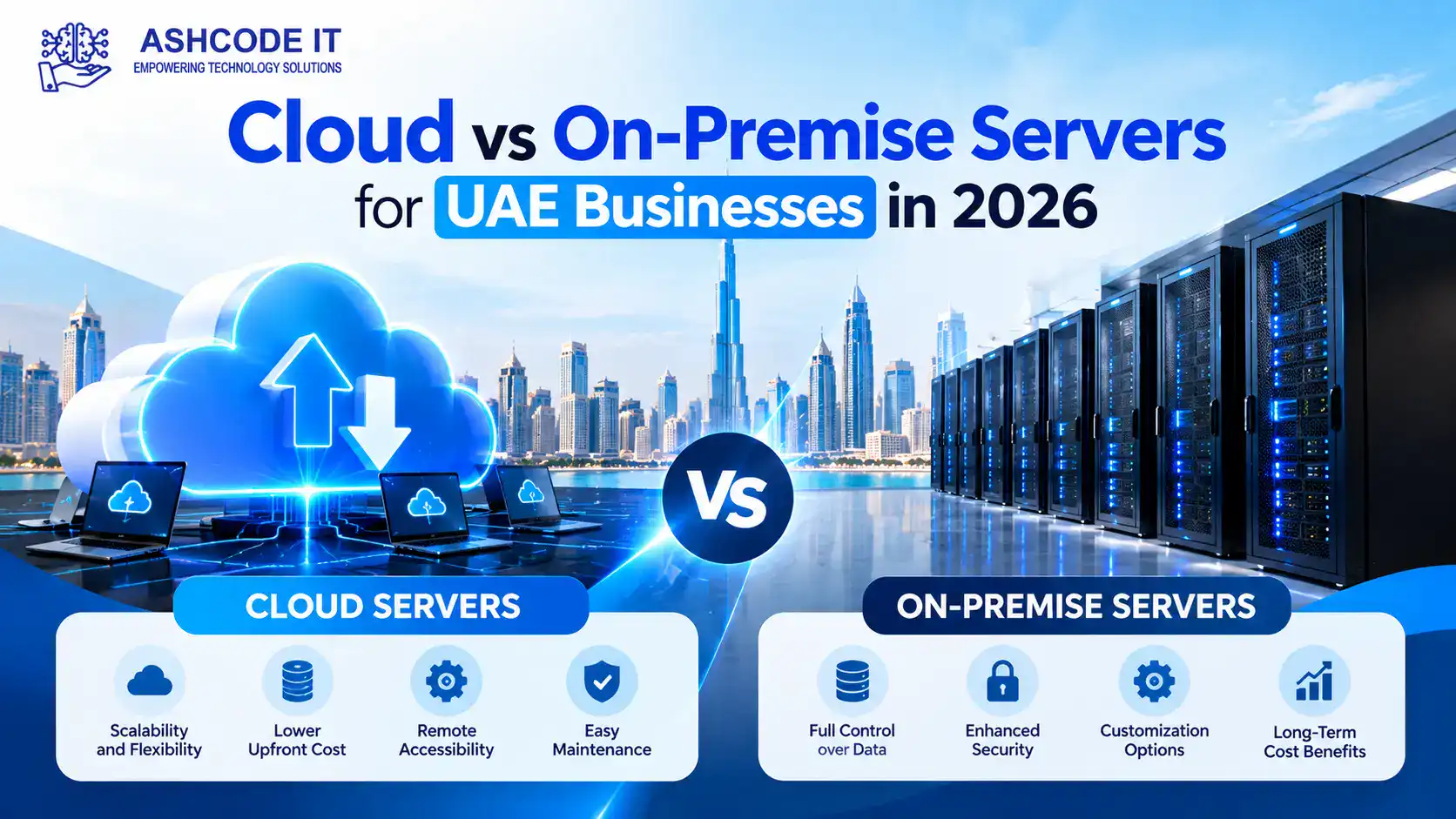
Cloud vs On-Premise Servers for UAE Businesses in 2026 is an important decision for companies planning their IT infrastructure. Both options can support business applications, data storage, cybersecurity, and daily operations, but they differ in cost structure, maintenance responsibilities, control, and recovery options.
For businesses in Dubai, Abu Dhabi, and across the UAE, the right choice depends on application requirements, available IT resources, security obligations, and long-term operating costs. In many cases, a combination of cloud and on-premise infrastructure may be the most practical approach.
What Is the Difference Between Cloud and On-Premise Servers?
Cloud servers run on infrastructure provided by a cloud service provider. Businesses access computing resources, storage, and applications over a network and generally pay according to their selected service plan and usage.
On-premise servers are physical servers installed at a company’s premises or in a facility it controls. The business or its IT service provider manages the hardware, operating systems, maintenance, and capacity planning.
Cloud vs On-Premise Servers: Key Differences
| Factor | Cloud Servers | On-Premise Servers |
|---|
| Initial investment | Usually lower hardware investment | Higher upfront hardware costs |
| Ongoing costs | Subscription and usage-based charges | Maintenance, power, cooling, and upgrades |
| Capacity changes | Resources can often be adjusted quickly | Additional hardware may be required |
| Hardware maintenance | Primarily handled by the provider | Managed by the business or its IT provider |
| Data control | Depends on provider, configuration, and contract | Direct control over physical infrastructure |
| Remote access | Available with suitable connectivity and security | Requires secure remote access configuration |
| Disaster recovery | Additional recovery services must be configured | Separate backup and recovery infrastructure is required |
Neither option is automatically cheaper or more secure. The result depends on how the systems are designed, managed, and maintained.
Benefits of Cloud Servers for UAE Businesses
1. Lower Initial Investment
Cloud infrastructure can reduce the need to purchase physical servers, storage devices, and supporting equipment before deployment. This can help startups and small businesses manage initial IT expenditure.
2. Flexible Resource Allocation
Businesses can adjust computing resources as application demand changes. This is useful for companies with seasonal workloads, temporary projects, or changing employee numbers.
3. Remote Access and Collaboration
Cloud-hosted applications can support employees working from different offices or locations, provided appropriate identity controls and network access are configured.
4. Access to Managed Services
Cloud providers offer services for monitoring, security, databases, backups, and disaster recovery. These features still require correct configuration, testing, and ongoing administration.
Benefits of On-Premise Servers
1. Direct Infrastructure Control
Businesses can control physical access, hardware selection, server configuration, and maintenance schedules. This may be important for specialized applications or environments with specific operational requirements.
2. Local Network Performance
Applications that frequently access large files or communicate with local equipment may benefit from a properly designed on-premise network.
3. Predictable Hardware Capacity
After purchasing the required equipment, businesses can plan around its available capacity and expected replacement cycle. However, power, cooling, maintenance, licensing, and hardware failures remain ongoing considerations.
4. Support for Specialized Applications
Some legacy systems, industrial equipment, and applications may require local infrastructure or have limited cloud compatibility. Confirm vendor support before planning a migration.
Security and Data Protection Considerations in the UAE
Cloud and on-premise environments both require strong security controls. Cloud services do not automatically remove cybersecurity responsibilities, and physically owning a server does not guarantee that its data is protected.
The UAE’s National Cloud Security Policy highlights areas including data security, access management, data location, contractual responsibilities, incident management, and cloud resilience. Businesses should assess these requirements alongside applicable laws and sector-specific rules.
Before choosing a cloud provider, check where data is stored and processed, who can access it, how backups are protected, and whether the contract meets your organization’s obligations. UAE businesses should not assume that every type of data must always be hosted inside the country; applicable requirements depend on the organization, data, and relevant regulations.
Should Your Business Choose Cloud, On-Premise, or Hybrid?
Cloud: Consider it for businesses that want to reduce hardware ownership and use hosted applications or adjustable computing resources.
On-premise: Consider it when applications require local hardware, specific physical controls, or infrastructure that cannot readily be migrated.
Hybrid: Consider a combination when some applications benefit from cloud services while others need to remain on local servers.
A hybrid approach can let businesses retain selected local workloads while using cloud services for collaboration, off-site backups, or disaster recovery. The systems must still be integrated and secured properly.
Ashcode IT provides IT infrastructure, server solutions, cloud services, networking, cybersecurity, and technical support for businesses in Dubai and across the UAE. Businesses evaluating server options can discuss their existing infrastructure, application requirements, backup arrangements, and support needs with the team.
Contact Ashcode IT